The Lesson
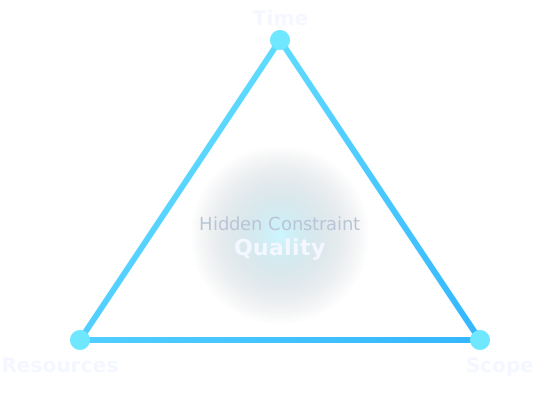
Three interdependent factors govern most projects: Time, Resources, and Scope. Lock two of these, and the third must change.
There is also a hidden fourth factor: Quality. When time, resources, and scope are all fixed, quality is often what silently absorbs the pressure.
My Professional Experience
I worked on a small analytics team consisting of one manager and anywhere from two to four analysts. We took projects from initial discovery meetings all the way through delivery and ongoing support.
That work required wearing many hats -- one of which was acting as a project manager.
The Story
I was in a meeting with a stakeholder, reviewing a mock-up dashboard, when I casually fielded a request along the lines of: "We would really like it if this could also have X."
Eager to please -- and to demonstrate flexibility and capability -- I responded with something like: "That's a great idea, I think we could do that!"
The stakeholder was happy. I was happy. What could go wrong?
Scope creep.
At this point in the project, we had already aligned on the key constraints:
- Time: when the dashboard would be published to production
- Resources: in this case, primarily me
- Scope: the agreed-upon dashboard, functionality, and data
This is where the concept of the Iron Triangle becomes relevant.
According to the Iron Triangle, an increase in Scope necessarily leads to an increase in either Time or Resources. More scope means more work. Either it takes longer for the same resources to complete the work, or additional resources are required to meet the original timeline.
Our team operated on a quarterly project cadence, while also reserving bandwidth for ad hoc reporting, user support, and other unplanned requests. Pulling in additional resources or pushing back delivery timelines would have had ripple effects across the entire team.
So what happens if a stakeholder holds firm on the new scope, the timeline stays fixed, and no additional resources are available?
That's where the hidden variable -- Quality -- comes into play.
To deliver more scope, in the same amount of time, with the same resources, quality is often what gets compromised. Less time means fewer tie-outs, reduced internal testing, and more limited user acceptance testing (UAT).
Fortunately, this story had a positive ending. We had built some leeway into our time estimates. While the scope increased, we were still able to meet our deadline.
Under-commit and over-perform -- a lesson for a future post.
Takeaways
When managing projects, keep the Iron Triangle -- Time, Scope, and Resources -- front of mind. A few principles help ensure success:
Be precise.
Clearly define scope and timelines upfront. Precision protects both the work itself and the people responsible for delivering it.
Document relentlessly.
When scope creep appears, documentation provides a shared reference point and enables clear, productive conversations about tradeoffs.
Don't default to "no."
New ideas are often valuable. Capturing them for a Phase 2 or v2 allows stakeholders to feel heard without derailing the current project.